








What AI actually costs in South Africa
Rand-denominated budgets, dollar-denominated APIs, and the costs South African teams keep missing.
AI Integration South Africa
Connect AI to your CRM, databases, documents and internal APIs. You may not need to replace your current software to get AI into your workflows.
Free consultation
Six questions, then pick a time.
Would rather just email? support@webparam.org

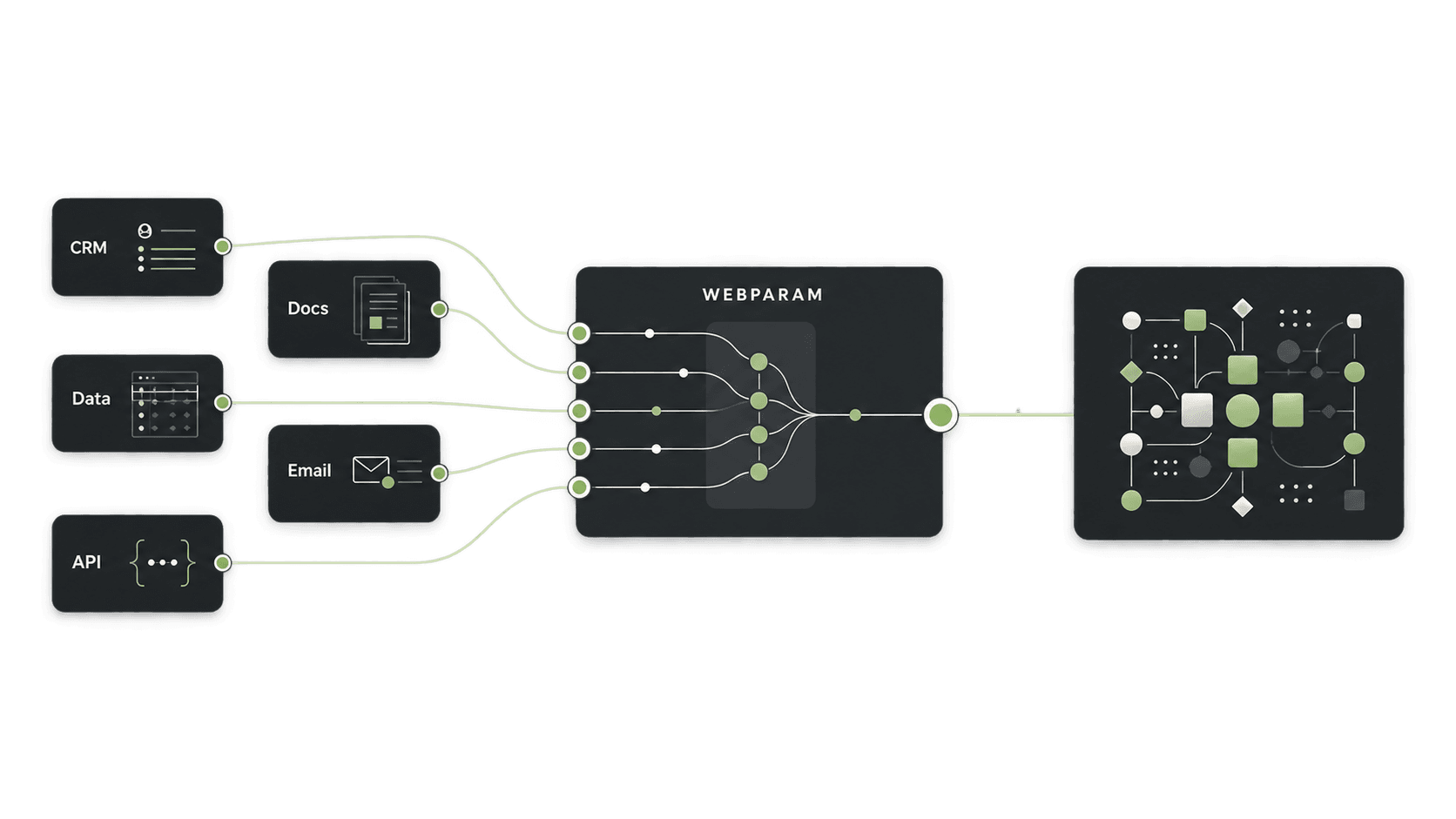
Three parts. Integration is the work of joining the first to the third through the second.
At a capability level. What is possible for a specific product depends on the interfaces it offers.
The same systems, with and without a layer that lets AI reach them.
Each one useful, none of them reachable by an AI system.
Capability that appears where the work already happens, not in a separate tool.
Answers and actions grounded in your own data rather than in general knowledge.
Results written back to the system of record, not left in a chat window.
An outcome starting the next step, rather than waiting for a person to notice.
Work that spans more than one system handled as one process.
Different steps of an integration reward different models. The catalogue is where that comparison starts.
Reading a scanned document, classifying an email, searching your own material and reasoning about what to do next are four different jobs. They are rarely best served by the same model, and an integration often uses more than one.
Integration explorer
Three choices, one drawn pattern. Runs entirely in your browser — nothing is sent anywhere.
What the systems are, what they expose, and what the process actually needs from them.
Establish reliable access to the data and the actions, with the right permissions.
Apply the capability the job needs at the step that needs it, and nowhere else.
Run it, watch what it does in practice, and improve it against real use.
You may not need to replace your current software.
Software that already works represents years of process knowledge, and replacing it to adopt AI is usually the most expensive route to the smallest gain. Where a system exposes its data and its actions, AI can generally be added alongside it. Where it does not, that constraint is worth knowing early — which is what the first conversation is for.
Grouped by what each model is built for, which maps closely to the steps an integration needs.
Integration raises questions that are worth answering before a build: which information leaves your systems, where processing happens, and what that means under your own data policies. Latency matters too wherever a person is waiting on a response rather than a batch job running overnight.
These are considerations to work through rather than blockers, and the sensible provider choice often follows from them rather than the other way round.

Rand-denominated budgets, dollar-denominated APIs, and the costs South African teams keep missing.
A local region doesn't mean local inference, a rand invoice doesn't mean rand exposure, and POPIA doesn't require in-country processing. The three questions South African teams should answer before committing to an AI provider.
AI integration is connecting AI capability to the systems, data and workflows a business already uses, so that it can work with real company information and act on the results. Without it, an AI system is a separate tool a person has to copy things into and out of.
In most cases, yes. At a capability level that covers CRMs, databases, internal APIs, document stores, email, knowledge bases, internal applications and approval workflows. What is possible for a particular system depends on what that system exposes, which is one of the first things a scoping conversation establishes.
Usually not. Integration is specifically the alternative to replacement: AI capability is added alongside what you run rather than instead of it. Whether that holds in a specific case depends on what your systems allow, but replacing working software is not the starting assumption.
Yes — that is generally the point. A retrieval approach lets a system find the relevant material in your own documents or records first and then answer from it, which is what makes answers specific to your business rather than generic.
Yes. The work is not tied to a single vendor, and the catalogue on this site exists so models and providers can be compared against the job in front of you rather than chosen by reputation.
Described by capability: CRM systems, databases, internal APIs, document stores, email, knowledge bases, internal business applications and approval workflows. The practical answer for any specific product depends on the interfaces it offers.
Identify one place where information has to be moved by hand between a system and a person, then send your details through the form on this page. The first call is a free 45-minute conversation about that connection.
Pick the place where information gets moved by hand. Free 45-minute call, no obligation.
Free consultation
Answer six questions and pick a time. No charge, no obligation.
Would rather just email? support@webparam.org