








Skip to content

AI Consulting South Africa

Make the right AI decisions before you build.

Decide where AI fits, which model and provider to use, and how to structure it — before you build. AI consulting for South African businesses.

Free consultation

Tell us what you're building

Six questions, then pick a time.

Organisation Type
What are you interested in?
Length
45 minutes
Cost
Free
Where
Google Meet

Would rather just email? support@webparam.org

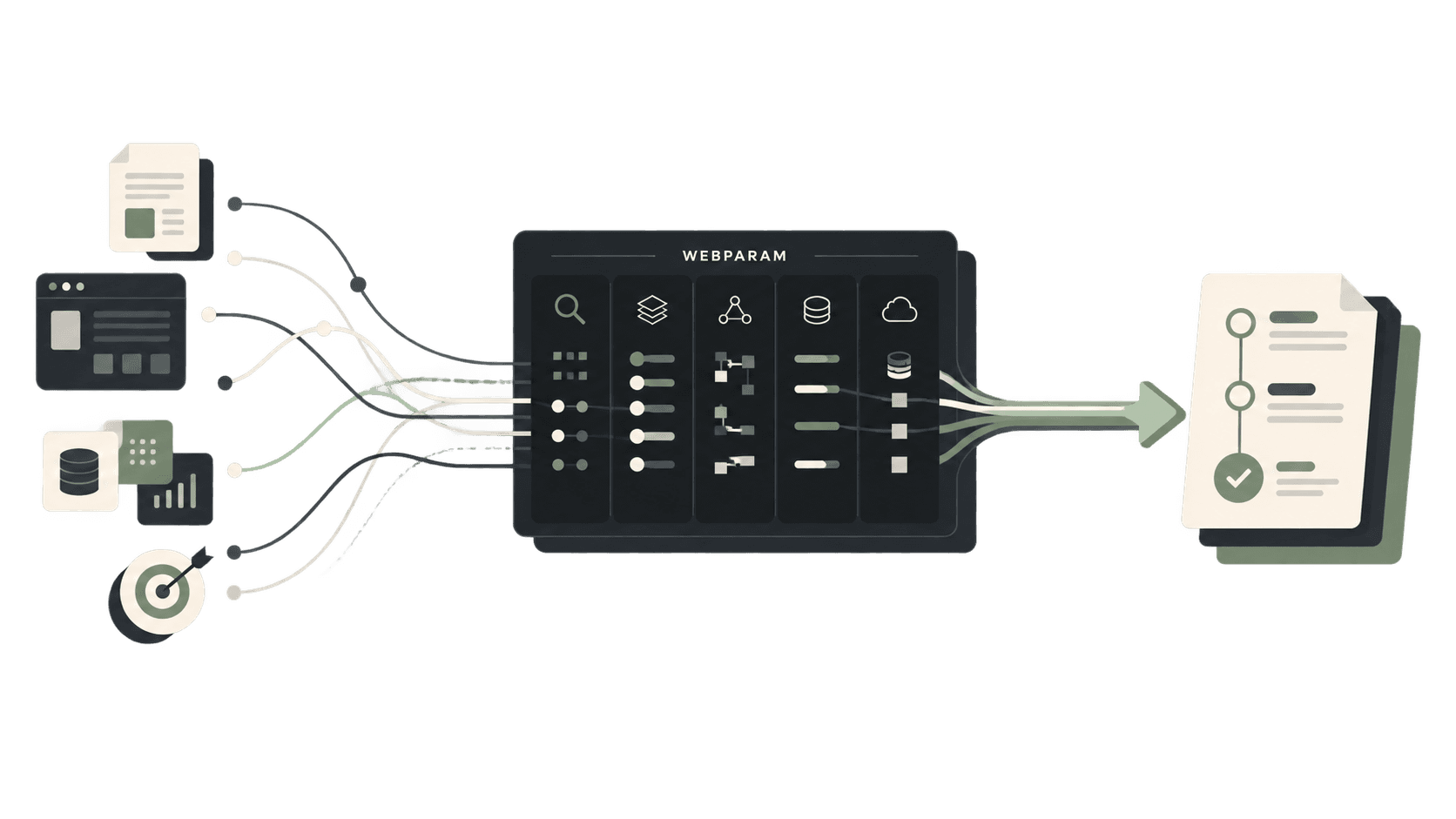
An illustration of an AI implementation plan being mapped out before a build begins.

What decision are you trying to make?

Most consulting conversations start with one of these five.

  • Where should we use AI?

    Opportunity mapping — finding the work where AI would change something, and the work where it would not.

  • Which AI model or provider should we choose?

    Model and provider selection against the actual job, its volume and its budget.

  • How should the system be structured?

    Architecture planning: what holds context, what calls what, and where a person stays in the loop.

  • What could it cost?

    Cost modelling for the workload as it would really run, not for a single example call.

  • What should we consider about data?

    Data and deployment considerations — what a system needs access to, and where processing happens.

From AI idea to implementation plan

Each step narrows the next. Skipping to the model choice is the usual way a project ends up rebuilt.

  1. Business goal
  2. Current systems & workflows
  3. AI opportunity
  4. Model & provider options
  5. Architecture
  6. Implementation plan

Choose AI based on the job, not the brand

Models differ far more by task than by reputation. The catalogue is built for comparing them on that basis.

Explore AI models

A model built and priced for reasoning is worth its premium on multi-step work and wasteful on classification. A smaller language model is often faster and an order of magnitude cheaper for extraction and routing. Which is the right answer depends on the job in front of you.

Compare providers →

What does an AI consulting engagement look at?

Ten things, in roughly this order. No score at the end — a number would only obscure which of them actually matters for you.

  • Business objective

  • Existing workflow

  • Existing systems

  • Data availability

  • AI capability required

  • Model and provider options

  • Cost

  • Architecture

  • Risk and human review

  • Implementation path

Deciding from South Africa

Budgets here are set in rand and providers charge in dollars, so a per-token price that looks trivial in one currency needs converting before it means anything against a real workload. Provider choice, where inference happens, and latency where a person is waiting on a response are all worth deciding deliberately.

These are considerations rather than obstacles — but they are the ones most likely to be missed when a plan is copied from somewhere with different economics.

  • What AI actually costs in South Africa
    What AI actually costs in South Africa
    Provider Deep Dives1 min read

    What AI actually costs in South Africa

    Rand-denominated budgets, dollar-denominated APIs, and the costs South African teams keep missing.

    Amara Okafor · August 5, 2026
  • Choosing an AI provider from South Africa: latency, rand pricing, and data residency
    Provider Deep Dives3 mins read

    Choosing an AI provider from South Africa: latency, rand pricing, and data residency

    A local region doesn't mean local inference, a rand invoice doesn't mean rand exposure, and POPIA doesn't require in-country processing. The three questions South African teams should answer before committing to an AI provider.

    Amara Okafor · August 4, 2026
  • What AI actually costs a South African team
    Provider Deep Dives3 mins read

    What AI actually costs a South African team

    Token prices converted to rands are the start of an AI budget, not the end of it. Where the gap opens between the pricing page and the invoice — output ratios, context re-billing, agent loops, forex, card fees and VAT.

    Amara Okafor · August 4, 2026

Pick one

What do you need help deciding?

Nothing is sent anywhere. This just shows what each decision involves.

How Webparam approaches AI consulting

  1. Understand

    The business objective first, then the systems and workflows that currently serve it.

  2. Evaluate

    Where AI would genuinely change the outcome, and where it would add cost without changing much.

  3. Compare

    Approaches, capabilities, models and providers, weighed against the job rather than reputation.

  4. Plan

    An implementation path with a sensible first thing to build and a way to tell whether it worked.

Explore AI by capability

Grouped by what a model is built for, which is the comparison that usually matters when choosing.

All categories

Also worth reading: the AI Consulting technical overview in the documentation.

AI Consulting docs

Frequently asked questions

What does an AI consultant do?

An AI consultant helps a business decide what to do before it commits to building. That means understanding the objective and the current workflow, identifying where AI would genuinely change the outcome, comparing the approaches and providers that could deliver it, estimating cost, and setting out an implementation path.

How can AI consulting help a South African business?

Mostly by preventing expensive decisions made on incomplete information. Provider pricing is set internationally, capability varies a great deal by task, and the architecture chosen early is costly to change later. Working those through before a build is usually cheaper than discovering them during one.

Can Webparam help us choose an AI model or provider?

Yes. The catalogue on this site exists for exactly that comparison — models grouped by what they are built for, and providers side by side. Which one suits depends on the task, the volume and the budget, which is what a consulting conversation works through.

Can you assess an existing AI project?

Yes. A review of something already underway or already live is a common starting point — looking at the architecture, the model and provider choices, the cost profile and where human review sits, and saying plainly what would change.

Do we need to know exactly what we want before speaking to Webparam?

No. Arriving with a problem rather than a specification is normal and is often the more useful starting point. The first conversation is about understanding the objective and the current systems, not about confirming a brief.

What happens after the consulting stage?

You have an implementation plan, and the choice of what to do with it. Webparam can build what was planned, or you can take it to your own team — the same people who write the plan are the ones who would implement it, which is what keeps it realistic either way.

Bring the question, not the brief

A free 45-minute call about what you are trying to decide. No obligation afterwards.

Free consultation

Tell us what you're building

Answer six questions and pick a time. No charge, no obligation.

Organisation Type
What are you interested in?
Length
45 minutes
Cost
Free
Where
Google Meet

Would rather just email? support@webparam.org